Tracing the Path of a Hot Carrier: The Journey Behind the Result

There is something strangely satisfying about seeing an idea that once existed only in our notebook become a paper that someone else can read.
A few days ago, my first PhD research work was published in Advanced Energy Materials.
The paper is the result of nearly two and a half years of work. It contains experiments, simulations, discussions, revisions, failed ideas, and a lot of data.
But when I look at the final paper now, it is easy to forget how different the journey actually was.
The paper looks like a clear scientific story.
The journey was anything but clear.
It was messy. It was slow. At times, it was confusing. And there were phases when I genuinely wondered whether we were going anywhere at all.
This is the story behind that paper.
It started with a DFT paper
The project started during a literature review.
I came across a DFT study discussing carrier dynamics in low-dimensional perovskites. It made me think about something that, at that point, I found quite interesting: what happens to hot carriers in a highly confined two-dimensional perovskite?
We know that hot-carrier dynamics in three-dimensional perovskites have been studied extensively, and there are established frameworks for understanding how carriers interact with the lattice and dissipate excess energy.
But moving into a strongly confined two-dimensional system changes the situation.
Now, excitons become important. The lattice is different. The organic and inorganic components are intimately connected. And the spacer cation, which can sometimes be treated simply as a structural component, can also influence the electronic environment.
So:
What happens if we systematically change the spacer cation and see how the hot-carrier dynamics respond?
It sounded like a relatively simple question.
It wasn't.
Synthesizing the molecules came first
Before we could answer any physics question, we first had to make the materials.
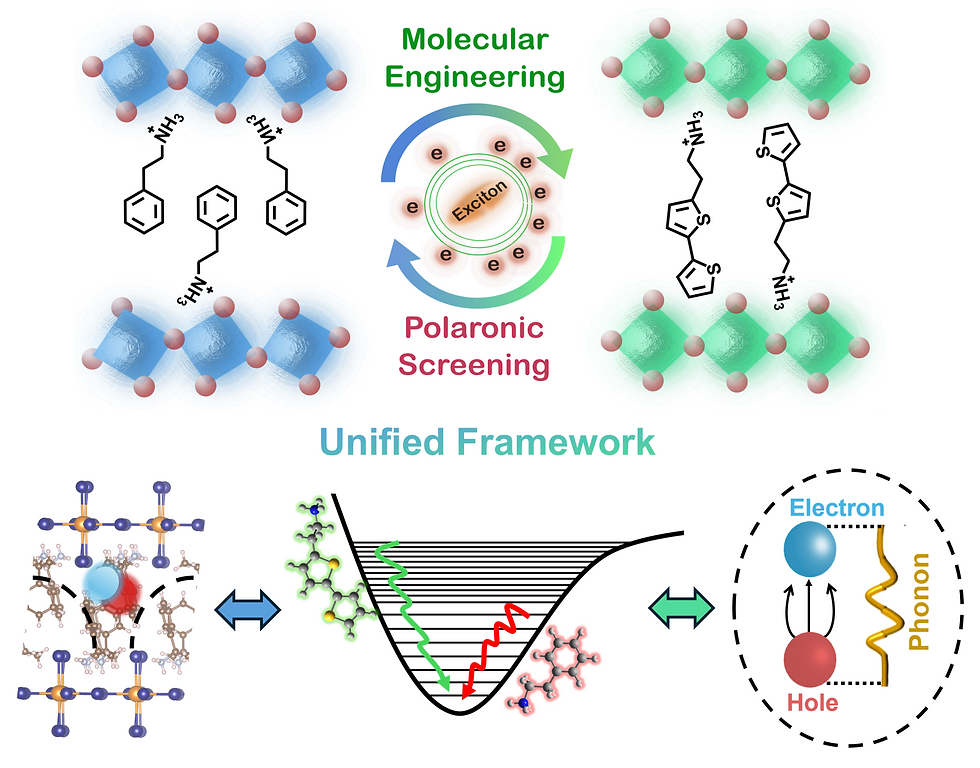
We decided to work with spacer cations that varied in structural rigidity and electronic characteristics.
The synthesis and optimization of these molecules themselves took months. Dr. Satyam Jena played a very important role in preparing and optimizing the spacer cations.
It took roughly five to six months before we were confident that we could reproducibly make the different systems and move forward with the experiments.
At that stage, we had a relatively straightforward hypothesis.
If the spacer molecule becomes more rigid, perhaps the lattice becomes more rigid, and the hot carriers should live longer.
It was a reasonable hypothesis.
Then we did the first transient absorption measurements.
And the result was almost the opposite of what we expected.
The more rigid bithiophene-based system showed faster hot-carrier cooling.
That was the moment when the project changed.
The result that made the project difficult
If the result had followed our initial expectation, the project might have been relatively straightforward.
We could have shown that increasing molecular rigidity changes the lattice, reduces certain vibrational motions, and consequently modifies hot-carrier cooling.
But that wasn't what we observed.
The result forced us to ask a much harder question:
If rigidity alone does not explain the cooling dynamics, then what else is changing?
And that question opened up the entire project.
We started looking at the system from different angles.
We performed more femtosecond transient absorption measurements. We looked at temperature-dependent photoluminescence. We studied the lattice through Raman spectroscopy. We worked with our collaborators on DFT and non-adiabatic molecular dynamics simulations.
The amount of data kept growing.
But having more data did not necessarily mean having more understanding.
In fact, for a while, it was almost the opposite.
When the project seemed to go nowhere
Perhaps the most difficult phase of the project was not a failed experiment.
It was losing motivation.
After working on something for a long time, there comes a point where you can look at all the data in front of you and still feel that you have nothing.
We tried different fittings, different analyses, and different ways of looking at the same measurements.
Sometimes an interpretation seemed promising, only for us to realize that it could not explain everything.
Then we would go back again.
That uncertainty was difficult.
When you don't know which direction to take next, motivation itself becomes part of the problem. You start putting less of yourself into the project, and that only makes it harder to move forward.
I was fortunate to have people around me during that phase who helped me enormously as we worked through the difficult parts of the project. Special thanks to Dr. Nilesh Saykar.
Because sometimes, when you are too close to a problem, you don't necessarily need another experiment.
You need another way of looking at the problem.
The importance of looking at the same data differently
One of the biggest lessons this project taught me is that a characterization does not necessarily have a single story.
You can perform one measurement, plot the data, and interpret it in one particular way.
But another person, with a different expertise, can look at exactly the same data and see something you completely missed.
That started happening in our project.
We began discussing the results extensively among the different members of the group and with our collaborators.
Everyone brought a different perspective.
Someone would think about the phonons.
Someone else would think about the electronic structure.
Someone would approach it from the excitonic picture.
Another person would think about the molecular contribution of the spacer.
And slowly, something started to click.
We began to feel that we were finally understanding what the data was trying to tell us.

The dots were beginning to connect.
That was the real turning point of the project.
In research, you cannot simply say, “This makes sense.”
You have to ask:
What evidence do we have to support it?
So we went back to the experiments.
We performed additional characterization, revisited prior data, tried different analyses, and examined the results from multiple perspectives.
And gradually, the scattered observations began to form a coherent picture.
Going back to the literature
Interestingly, once we had a strong hypothesis, we went back to the literature again.
This time, the literature review felt completely different.
At the beginning of the project, we were asking:
What is already known, and what questions can we ask?
Now the question had changed:
How does what we are observing fit into what is already known, and what can we contribute to the community?
So we essentially went one step backward to move forward.
We looked again at how other researchers had understood similar phenomena.
We compared those ideas with our observations and sought to understand which parts of the existing picture could explain our results and which could not.
This helped us refine our hypothesis.
And then we went back to the data again.
That cycle continued:
literature → hypothesis → experiment → analysis → discussion → literature again.
Eventually, the different pieces began to converge.
And that is how we developed our final framework for understanding the cooling dynamics in these low-dimensional perovskites.
There was no single answer
The final picture taught us something that I found particularly interesting.
No single phenomenon controlled the hot-carrier cooling dynamics.
A low-dimensional perovskite is not just one component doing one thing.
Even when we tried to keep most of the system constant and change only the spacer cation, that one component affected the system much more than we initially anticipated.
It changed the phononic landscape.
It changed the excitonic environment.
It changed the rigidity of the lattice.
It changed the electronic and orbital contribution from the spacer.
And ultimately, all of these factors influence how the excited state interacts with the lattice.
Our final framework, therefore, brought together several interconnected pieces.
The phonon measurements helped us understand how phonon-assisted relaxation changed between the different systems.
The exciton–polaronic picture helped us understand how the excited state interacts with and distorts the lattice, and how polaronic screening can influence the cooling dynamics.
And the electronic-structure calculations showed that the spacer molecule cannot simply be considered an inert structural component. Its orbital contribution also matters.
None of these perspectives, by themselves, could explain the entire picture.
Together, they could.
And that made sense of something that had initially confused us so much:
Why did changing the spacer molecule produce a result that was so different from our original expectation?
Because we were never changing just one parameter.
We were changing an interconnected organic-inorganic system.
The paper that finally emerged
By this point, the project had already taken us through a long chain of experiments, analyses, discussions, and collaborations.
There were transient absorption measurements.
There were Raman measurements.
There were low-temperature optical measurements.
There were DFT and non-adiabatic molecular dynamics calculations.
There were countless discussions about how one observation connected or failed to connect with another.
The final paper was therefore not built around one experiment.
It was built around the convergence of different pieces of evidence.
And that, in many ways, was also the answer to the original question.
The different techniques were not just there to make the paper comprehensive.
Each one gave us a different way of looking at the same physical problem.
And then came the publication journey
Getting the science together was only one part of the journey.
The paper itself also had a long road ahead.
It was rejected by two journals.
It was also rejected after review at Advanced Energy Materials.
At that point, after spending so much time on the project, rejection was difficult to take.
But we believed there was a scientific story worth communicating.
So we went back to the manuscript, worked through the concerns, and prepared a detailed response to the editor and reviewers.
The manuscript went through another round of evaluation and revision.
There were more questions to answer, more analyses to clarify, and more work to do.
Nearly another year passed in that process.
And finally, in September 2026, the paper was accepted in Advanced Energy Materials.
Seeing that acceptance was obviously a very happy moment for me.
It is my first PhD research paper.
But more than the publication itself, I think about everything that happened before that acceptance.
Looking back
When I started this project, I thought I would study how changing a spacer molecule affects hot-carrier cooling.
What I ended up learning was much bigger than that.
I learned how complicated a seemingly simple scientific question can become.
I learned how uncomfortable uncertainty can be.
I learned that having a lot of data does not automatically mean you understand your system.
I learned to question my own interpretation.
I learned to look at the same result from different perspectives.
And perhaps most importantly, I learned that a project does not have to make sense at every stage for it to eventually become a coherent scientific story.
The published paper is the final product.
But the real research happened in all those moments when the answer wasn't clear.
The failed directions.
The long analyses.
The confusing results.
The discussions.
The moments of doubt.
And eventually, the moment when the pieces finally connected.
That was my first paper.
And perhaps the biggest lesson I am taking forward from it is simple:
Science rarely follows a straight line. We just have to keep finding our way through it. Design Strategy for Influencing Hot Carrier Cooling Dynamics in Low-Dimensional Perovskites


Inspiring